
Process and SLAs
This section covers the standard & emergency support process, SLAs, people involved and escalation matrix.
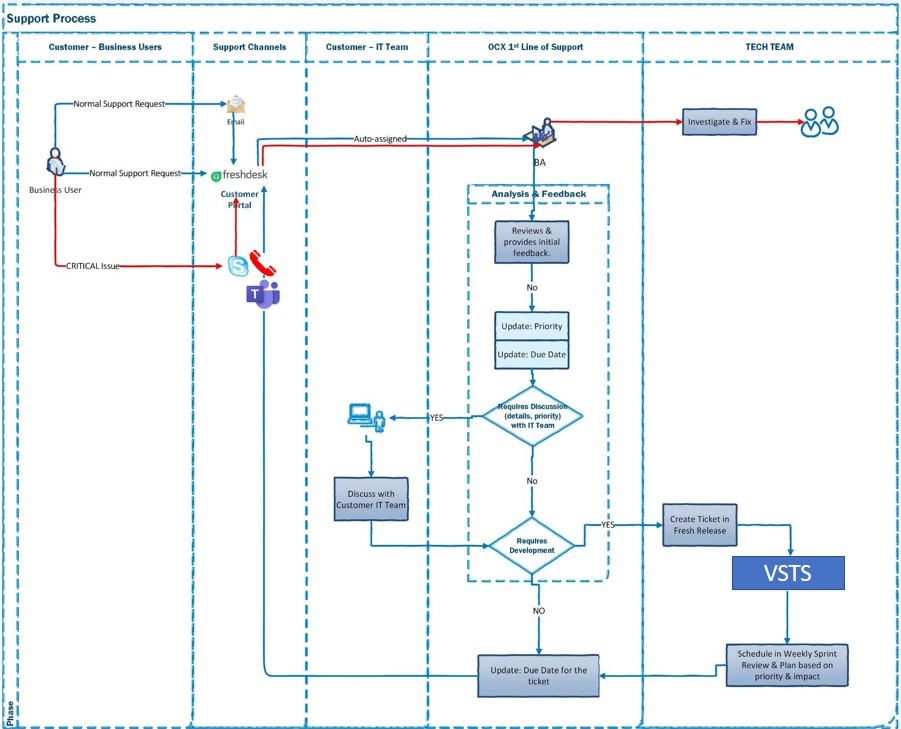 The infographic above visually represents the standard and emergency support process.
Standard Support Process
The standard support process involves several steps to effectively address and resolve customer issues from Triaging to analsys to resolution. Let's dive into each step in detail.
- eCommerce Team triage the issue and create ticket on Freshdesk portal or send across the detail via email, with the details including the priority.
- L1 Support Analyst reviews the ticket and categorizes it based on the description. The categories include BUG, Feature Request, Existing Scope, Information Request, General Support, Duplicate, Change Request.
- Initial Response and Impact Assessment: After the initial review, the L1 support team provides the first response according to the SLA and assesses the impact of the issue.
- Ticket Assignment: The ticket is assigned to the L2 support team if further investigation is required.
- Ticket Status Management: By default, the status of the ticket is set to OPEN. Definition of statuses below.
| Status | Description |
|---|---|
| Open | Newly created ticket, yet to be responded to or reviewed. |
| Pending | First response sent. |
| Review Required | Further input needed from the L2 support or development team. |
| Waiting on Customer | Further clarification or data needed from the customer. |
| Waiting for Development | The issue is decided for development (bug fix or change request) but not yet picked up for development. |
| In Development | The issue has been picked up for development in the sprint. |
| BC Testing | The issue is deployed on Dev/Beta and testing is being conducted. |
| Resolved | The issue has been positively tested, deemed resolved, and communicated to the customer. |
| Closed | Clients can mark the ticket as closed after verifying the resolution. If not closed by the client within two weeks, the ticket is automatically closed. |
Emergency Process
- Business Users identify a critical issue severely impacting the business. for example some:
- Users unable to place an order
- Site running extremely slow
- Users unable to add an item to the basket
- Critical pages (home page, search, product lister) throwing errors and preventing access
- eCom Manager contacts BetterCommerce support via online messenger or mobile phone to report the incident.
- An incident call is set up, including all crucial team members.
- All communication is centralized and documented, including actions taken, root cause analysis, fixes, and potential impacts.
- The incident response team analyzes the issue and provides the first analysis within 2 hours.
- Updates are provided every 15 minutes through the open chat channel.
- The team endeavors to resolve the issue as soon as possible.
- A detailed incident report is curated and shared with all involved members.
- Incident reports are logged and stored in a centralized location for future reference and training purposes.
People
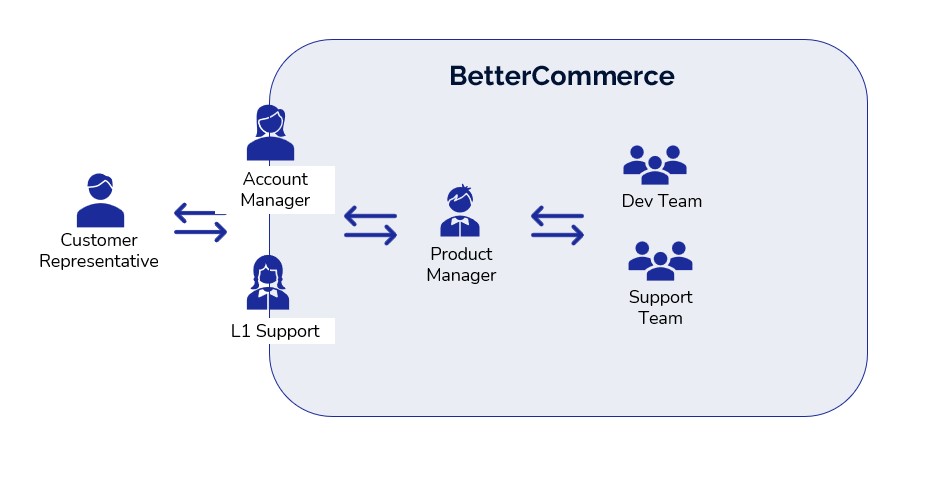
The support process will involve the following people
Escalation Matrix
| Level | Role | Contact | Criteria for Escalation | Communication and Action Plan |
|---|---|---|---|---|
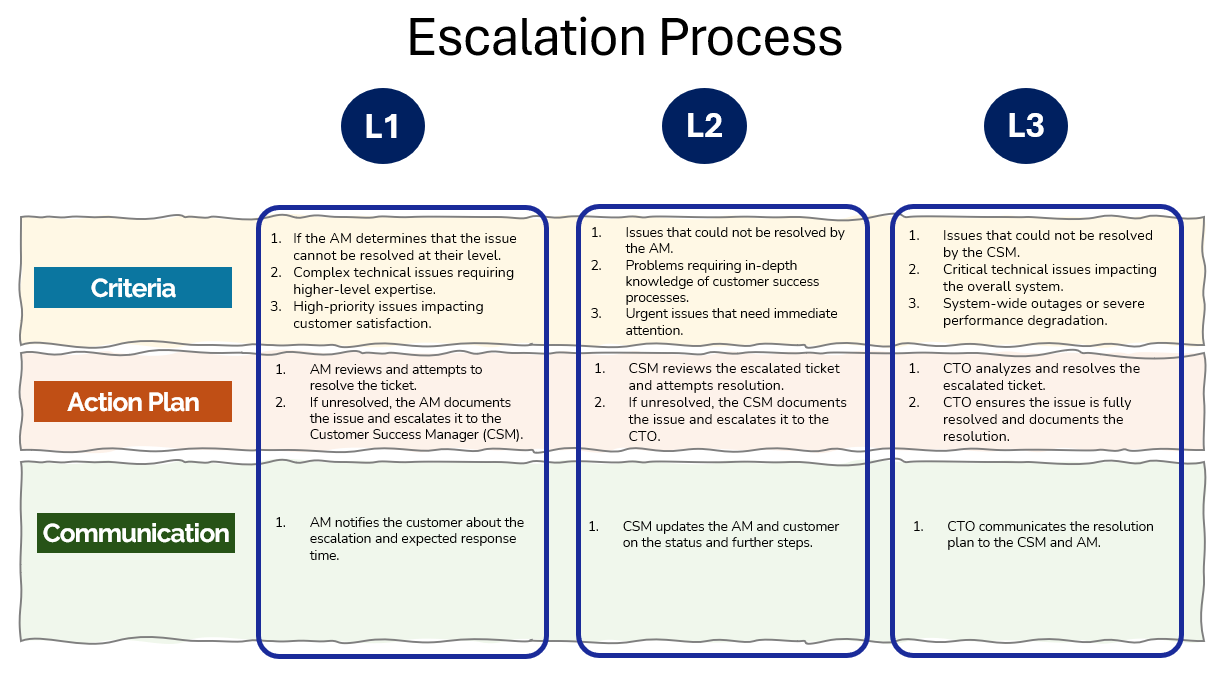
| Level 1 | Account Manager (AM) | Specific to Customer | Issues unresolved at the AM level within the stipulated time based on severity will be escalated: Critical (30 mins), High (1 hour), Medium (8 hours), Low (16 hours) | Analyze ticket, attempt resolution; if unresolved, notify CSM |
| Level 2 | Customer Success Manager (CSM) | Sanjay Kumar | Issues unresolved at the CSM level within the stipulated time based on severity will be escalated: Critical (30 mins), High (1 hour), Medium (8 hours), Low (16 hours) | Analyze ticket, attempt resolution; if unresolved, notify CTO |
| Level 3 | Head of Product | Vikram Saxena | Issues unresolved by Level 2; critical system-wide issues | Analyze and resolve escalated tickets; communicate resolution plan |
Engagement Models
| Ticket Type | Description |
|---|---|
| Bugs | any bugs reported in the core platform are fixed at the cost of the vendor (BetterCommerce) as part of the standard support and are not charged to the customer. |
| Change Requests / Enhancements | If the change request is completely bespoke to the customer, the customer is charged 100% of the development cost at the agreed billing rates. If the change request are something which can be useful for other clients as part of the platform, they are made part of the core product roadmap and customer is only charged 40% of the actual cost as per the aligned billing rates. |
| Custom Projects | the customer is charged 100% as per the agreed billing rates or fixed price on project-by-project basis. |
Enhancements
- All the clients have an Account Manager. typically, an account manager manages a maximum of 2-3 clients.
- Typically, for larger clients we provide a dedicated pool of 1-3 developers depending upon the requirements/scale and commercial alignment.
- These resources are billed on a monthly basis, work dedicatedly on the client enhancements, and work alongside the client as per their sprints.
- The account manager coordinates, plans, and reports directly to the customer project manager on the requirements, deliverables, and provides a monthly timesheet of the resources.
- For clients where we dont have a separate dev team, the requests are added to standard product backlog and processed as per internal backlog review process.
Custom Projects
- In scenarios where clients have a strategic project that needs support from the core platform or needs to be integrated into the core platform, the following process is followed:
- The client provides their requirements.
- The BC team discusses, evaluates the project, and puts together a high-level specification and effort estimation.
- In general, we prefer to do fixed-price projects rather than loose-ended projects.
- We provide a fixed price cost, effort, and time estimate for the project.
- Based on the alignment, the project is then kicked off and coordinated by the members of the core development team.